Thursday, April 11, 2013

Lunch With A Side Of Excommunication

Those three words are an incantation capable of powerful magic. To speak them is to be transported to another time and place.

Try it: high school cafeteria.
Can't you just feel the air heavy with grease and gossip? Smell the sloppy joes and social anxiety? See the heaps of tater tots rapidly congealing and the heartless interpersonal hierarchy being enforced  like some particularly gruesome scene from Mutual of Omaha's Wild Kingdom?1

As high school cafeterias go, the one at Pembroke Academy, where I spent most of my high school career, was worse than most. The school had been built into a hill and over the years, additions had been tacked on in a haphazard and inelegant manner. Half the cafeteria was in one of the newer portions of the building--it had high ceilings and tall windows that let in lots of light. The other half of the cafeteria was in the basement of the oldest part of the school--it was windowless and dimly lit with a claustrophobically low ceiling. The kitchen and serving lines were in this cave-like space along with as many tables as fire regulations would allow, all the better to cram in as many freaks, geeks and social outliers as possible because, of course, the sunny side of the cafeteria was reserved for those with some measure of social standing.

I was a cave-dweller, huddled with my friend Toni at a round table near the snack bar window. By default, we sat with three people we barely knew: Jon, who rode my bus and Joanne and Suzanne, who were friends with each other. For most of the school year, the five of us didn't really eat lunch together, we ate lunch near each other. Toni and I carried on one conversation while Suzanne and Joanne carried on another and Jon did mysterious nerdy things involving hieroglyphic markings on oversized sheets of graph paper.

It seemed likely that Joanne and Suzanne had been exiled to the dark side of the cafeteria primarily for their academic achievements and for the primness they both radiated. Joanne, especially, gave off an air of displaced royalty--she spoke fluent French, quoted Shakespeare, and stopped just short of raising her pinky finger while daintily sipping from her carton of chocolate milk. She seemed to be patiently biding her time among her lowly subjects until she could be rescued by her knight in shining armor from the evil witch's curse that had banished her here in the first place.

It happened that Joanne, Suzanne and Toni did have one thing in common--all three of them were Catholic. While Joanne and Suzanne were apparently church-going Catholics, Toni was more of what I guess you'd call a "cultural Catholic." She and her family did not regularly attend church, but many of the traditions of the Church seemed to be deeply embedded in their DNA.

For Lent that year, Toni had given up meat--not just on Fridays, but for the whole forty days. She seemed to be doing okay, until one Friday, when I noticed she was staring a little too intently at the pepperoni on my pizza.

"I really, really want that pepperoni," she said, reaching for it.

"It's Friday," Joanne warned.

Toni's hand paused for a second, as she considered the fate of her immortal soul. "I know," she said, "but it's just one tiny pepperoni."

"You can't," Joanne said. "It doesn't matter how big it is, it's still meat."2

Toni snatched the pepperoni from the top of my pizza and popped it into her mouth.

Joanne gasped. "You are no longer a member of the Catholic Church."

Toni licked a string of cheese from her finger and said, "It was worth it."

J is for Judgment

1. Lions? Lions aren't ruthless. I'd take a pride of hungry lions over a gaggle of teenage girls any day.

2. An argument could be made that high school cafeteria pepperoni is not really meat at all, but I doubt Joanne would've been swayed.

Wednesday, April 10, 2013

With Friends Like Those...

When I was very young, between the ages of two and three, I kept company with a pair of imaginary friends--Julie and Johnny. Though I was too young at the time to have any reliable memory of the two of them1, my relationship with them was so intense, my mother included them on my "Favorite Things" page in my baby book. Not only that, but I believe Julie and Johnny are the reason Lora, a little girl who people besides me could see, is listed as my first real friend. 

Despite their unwillingness to show themselves to anyone else, Julie and Johnny had no trouble occupying me--I spent whole afternoons playing with them, carrying on long conversations and even demanding that my mother make sandwiches for them at lunch time. The way my mother told it, Julie and Johnny only faded away when we moved to a different town and Lora came into my life.

For most of my life, I've thought of Julie and Johnny as just one more layer of quirk, but recently2, I have started to wonder if Julie and Johnny were more supernatural than imaginary.

Once that possibility crossed my mind, I remembered the months after Son-One learned to crawl and then walk. Very often, he would make his way toward the same corner of our tiny apartment's tiny kitchen. He would sit on the floor, facing the corner, his eyes focused on something none of the rest of us could see. Sometimes he would speak to whatever or whomever it was he saw, stringing baby syllables into sentence-like structures--questions, demands, declarative statements. Mostly though, he sat and watched intently in a way that became eerie over time.

After months of this, when Son-One was not quite two, we moved to another apartment and we never saw him "corner talking" again.

So, what say you, my bloggy friends? Quirk or clairvoyance? Is either of them hereditary? And do you have any experiences with either one that you'd like to share?

I is for Imaginary


1. Memory is a such a strange and slippery thing. For most of my life, when I've thought of these two, I've thought of them as Jean and Johnny. Tonight, when I was double checking my baby book for my mother's notations on the subject, I discovered that my mother had referred to the female counterpart as "Julie." I had absolutely read that note before, but somehow had forgotten the written version in favor of my own recollection of "Jean." Based on the ink color and handwriting and the timing of other entries, my mother's note about Julie and Johnny was written around the time I was eight, about five years after my friendship with Jean/Julie and Johnny had ended. Did she misremember Jean's name as Julie as that point? Did I misremember Julie as Jean all along? Or did my mother at some point begin substituting Jean for Julie in her oral version of the story, which I heard a million times and internalized? Or, perhaps, I remember more about Jean and Johnny than I realize? Wherever it may have come from, Jean is so embedded in my psyche that it was an effort to type Julie throughout this entry.

2. The timing may or may not be related to excessive viewing of Celebrity Ghost Stories, where a surprising number of episodes feature childhood friends of the disembodied spirit variety. Hey! If it's good enough for Daryl Hannah, it's good enough for me.

Tuesday, April 09, 2013

Does That Come In A Slightly Smaller Size?

In January, I attended a suicide intervention training1 that involved role-playing exercises. We separated into pairs with one partner playing the caregiver and the other playing the at-risk individual in "performances" in front of the whole workgroup.

One of the teams was comprised of a mother and daughter who were attending the workshop together. The guidelines for this particular program call for the caregiver to encourage the at-risk person to first talk about the reasons she wants to die and then move on to the reasons for living. As the at-risk person, the mother painted a bleak existence for her character--a widowed, childless nurse who was being forced into retirement after 35 years of loyal service. The mother was so convincingly distraught that the daughter struggled to find a positive with which to help her start her list of reasons to live.

When the two of them finished their presentation, another woman in our group asked the facilitator how to handle a situation where "everything in a person's life seems so awful that you can't think of anything good to tell them."

The facilitator turned the question over to the group and, looking for clarification, I asked the questioner, "Are you asking how do you find hope in the face of suckishness?"

The woman's eyes lit up. "Yes," she said, "that's it exactly."

"Well," I answered, "I think that's really one of those core life questions, isn't it? That we all kind of have to answer on our own."

Feigning dismay, she said, "So you're telling me you don't have the answer either?"2

A few weeks later, I was sitting with a friend, an avowed and sometimes vehement atheist, who was trying to move on from the mistakes of his past, but was not at all sure what to do with his future. He was struggling to find a path that felt meaningful and he said, without that meaning, he didn't really see the point of making an effort at change at all.

It hit me that he, too, was talking about hope in the face of suckishness, albeit in a different way than the woman at the training. Even as atheists, we can see that hope in the face of suckishness is one of those things that religion often gets right. Religion offers not just faith, but fellowship and tradition, that can help to fill that hollow spot where hope should be.

For nonbelievers, the search for something big enough to fill that enormous emptiness is daunting. It's an easy thing to say that everyone must figure out for themselves how to fill that void, but much less easy to live with that void in the meantime.

That day, my friend and I eventually had to concede that we'd discovered no easy answers--no answers at all really. But we had at least felt comforted by talking with someone who struggled with the same questions.

It was a couple of days before it finally occurred to me that far from being a consolation prize, that sense of connection, of having found a fellow searcher, was actually part of the answer. A little part, sure, but lots of big things are built of little parts.

"How do I find hope in the face of suckishness?" may be a big question but, for me, the answers turn out to be small ones, or at least a big appreciation for small things: moments of true connection with family and friends, words strung together in a way that makes a bit more sense of the world, that male cardinal this morning at the tippy top of the still-bare silver maple across the street singing at a volume clearly meant to prove once and for all that body weight has no direct correlation with decibel output. 

Taken together, the little things add up to more than enough hope. It's just a matter of remembering that they do.


H is for Hope

1. ASIST. Highly recommended, by the way.

2. The facilitator stepped in then and answered the original question regarding how to steer someone toward reasons to live when there seem to be so many negatives stacked against them. He said that while it's not much, the fact that the person is willing to talk about suicide shows a willingness to live and that they are having the conversation at all can be just enough to build on.

Monday, April 08, 2013

Masked Mom's Media Monday: Celebrity Ghost Stories

One of the most mysterious things about Celebrity Ghost Stories*, a show full of mystery, is how the hell I ever ended up watching it in the first place. I've never been a channel surfer and since the advent of the DVR, my television viewing is purposeful and limited to a handful of shows that are set to record. I rarely even check the "guide" to see what I might be missing. But, somehow, perhaps steered by the invisible (ghostly?) hand of Fate, I stumbled across Celebrity Ghost Stories and watch it I did.

And then I watched it some more. In the month or so since I first stumbled upon it, I have deliberately watched 25 to 30 episodes of Celebrity Ghost Stories. It's fabulous. And awful. Its sheer awfulness may well be the most fabulous thing about it.

In each episode, three or four celebrities share their personal paranormal experiences. The show appears to define "celebrity" somewhat broadly, but many of the faces, if not all the names, are instantly recognizable. Just in case, though, each segment is introduced with a white-on-black, all caps Powerpoint-style graphic briefly detailing the storyteller's celeb credentials as well as providing a teaser for the upcoming tale of the supernatural.

These teasers are set to ominous music and make strategic (and melodramatic) use of ellipses. For example: 

[Screen One] LORENZO LAMAS, THE SON OF ACTORS FERNANDO LAMAS AND ARLENE DAHL, IS CONSIDERED HOLLYWOOD ROYALTY.
 
 
[Screen Two] YEARS BACK, HE AND HIS FAMILY WERE VISITED BY ANOTHER ESTEEMED MEMBER OF THE HOLLYWOOD COMMUNITY...
 
 
[Fade in]...WHO HAD ALREADY PASSED.


The stories feature first-person ghostly and spiritual encounters of all kinds and are told in narrative monologues. Threaded through the on-camera shots of the present-day celebrity seated in front of an unadorned green and black backdrop is the dramatic reenactment of the celebrity's ghost story. With few exceptions, the tone the celebrities use to relay these extraordinary happenings is calm and matter-of-fact, which only serves to highlight the over-the-top hysteria of the reenactments.

While I believe paranormal phenomena are possible in the abstract, I do not find most personal experience stories to be especially credible, which is not to say I think people who tell these stories are being deliberately untruthful. Rather, I know that eyewitness testimony of all kinds is notoriously unreliable and then add to that the vast number of these occurrences that take place just upon waking or just before falling asleep or (as in the case of numerous celebrities) in the presence of drugs or alcohol of various quantities, it just seems likely to me that many, many of these specific stories are more likely explained by less otherworldly means.

I think I watch Celebrity Ghost Stories more as a "Whose Going To Turn Up Now?" sort of thing than as a documentary on spooky stuff. A recent episode featured Natalie from Facts of Life, Dr. Spencer Reid from Criminal Minds, Rhoda from The Mary Tyler Moore Show, and Jamie from Charles In Charge. Some of the most surprising guests have been Sugar Ray Leonard, Dick Cavett, and Joan Rivers.

At this point, I'm close to burning out. I'm sure the moment is coming soon when I will shut off an episode mid-way through and never watch the show again, but in the meantime, I'm going to enjoy every awful, fabulous moment.


Masked Mom's One-Word Review: Awfabuloful.

G is for Ghosts

*New episodes of Celebrity Ghost Stories appear at 8 p.m. on bio.

Saturday, April 06, 2013

Everybody's Got One

A couple of months ago, two of Daughter-Only's music-crazed friends were raving to one another about a band they both love. When A.M. announced that the band was indisputably the best in history and anyone who thought otherwise was just wrong, S.A., pretending to be the voice of reason,said, "They have just as much right to their own opinion as you have to the correct answer."

It was a clever quip and when A.M. shared it with me, I chuckled appreciatively before launching into a mini-rant about how our societal inability to differentiate between facts and opinions is ruining our country and maybe even the world. A.M. mostly ignored my hysterics because he has spent enough time around Masked Mom headquarters to have grown accustomed, if not entirely immune, to my outbursts about the falling of the sky and my upcoming trip to go and tell the king.

When a teenage boy mistakes (or pretends to) his adolescent fanaticism for an objective fact, it's expected and maybe even endearing. But when so many adults imagine opinions, innuendo and rumors to be equal (or even superior) to facts and common sense, it can be demoralizing and maybe even dangerous.

It's not news that the internet is a fertile environment for the spread of not news--fictional "facts" passed from person to person, often gaining velocity and toxicity as they go. Most days, Facebook is less a social network than it is a clearinghouse of crap.

In late February, a Facebook friend of mine posted a particularly disturbing example of internet journalism: the "breaking news" that a provision of Obamacare mandates that all Americans be implanted with RFID microchips by March 23, 2013. Apparently, these chips would not only collect (and transmit) personal health information, but also link directly to your bank account. My friend shared this story with the comment, "Whoever approved this should be fired."

On the face of it, the story struck me as outlandish and paranoid. Even if the concept were believable, the timing was not remotely feasible. Here it was, the end of February with the March 23 deadline fast approaching and no one I knew (and, I think it's safe to assume, no one my friend knew) had yet been implanted, which meant our unwieldy and inefficient government was somehow going to implant 300 million-plus individuals with RFID microchips in a few short weeks.

Speaking of time, the amount of time it took me to research and thoroughly debunk the microchip story was less than five minutes. (Snopes.com and factcheck.org are good starting places.) I sent some links to my friend in a private message and, to her credit, the post disappeared from her timeline within minutes.

I was left wondering--and not for the first time--what criteria people use when choosing to share this sort of thing. Clearly, credibility is not an issue, much less truthfulness. For many people, how believable a story is seems to coincide exactly with how well it reinforces their own preconceived notions and opinions.

Now, don't get me wrong, I like opinions as much as the next girl--some of my best friends have opinions. What's more, many of my best friends have opinions that differ significantly from my own on some pretty major issues. To an amateur student of human nature such as myself, other people's opinions can be fascinating and even revealing.

Whatever else opinions may be, though, they are not facts. Ideally, our opinions are built of facts rather than our "facts" being built of opinions.

F is for Facts


Friday, April 05, 2013

Somebody Get Old McDonald On The Phone: How Did We Ever Settle An Argument Before The Internet?

Most of the time, we buy our eggs from the regular old grocery store, but every once in a while, we get a couple dozen directly from a local farmer. The eggs from the grocery store are perfectly adequate--white-shelled, uniformly sized and mostly free of imperfections, but the farmer's eggs are glorious to behold--varying shades of blues and browns and greens, speckled and solid, petite and jumbo, covered in gritty bumps and pristinely smooth, all nestled together in a single carton.  I get a little giddy just lifting the lid. It's all I can do not to pet them.


That such diversity comes from birds we classify all under a single name is fascinating, and, yes, delightful to me. It also reminds me of a batty and brilliant woman I once knew named Lee. I learned a lot of things from Lee, but probably none as valuable as the one she didn't mean to teach me.

I first met Lee in 1983 when my mom dragged me to Burger King, where they both worked and I would begin working a few months later, to help with a display for the debut of Return of the Jedi. I think my mother drafted me into helping less because she and Lee needed the help and more because I had only rarely left the house since we'd moved to New Hampshire two months before. By that point in my Army brat career, I didn't make friends, I waited for them to make me.

Helping my mother and her fifty-something coworker assemble an X-wing fighter from cardboard and papier-mâché wasn't really an opportunity to meet people my own age, but it would at least get me off the couch where I'd been wallowing in a Funk intensified by the culture shock of moving to a place where "aunt" rhymed with "taunt," sodas were all "tonics," and "wicked" was a wicked annoying modifier used in place of "very."

On that day, and pretty much always, Lee's short, dark hair was a mess of multidirectional cowlicks. She was wearing maroon polyester pants with a broken fly. The gold safety pin she'd driven through the flaps failed to close the gap, but succeeded in sending a clear message: Lee had known her zipper was broken and had left the house anyway. She had more important things to worry about than how she looked.

She was the mother of five grown children, the wife of a minister. She was a chain smoker with a barking laugh and a playful glimmer in her eye. She could be impatient and hot-headed. She was opinionated and outspoken, occasionally foul-mouthed. She was given to speaking in pronouncements, sound bites coated in her authoritative voice.

While training me at the register at Burger King, she told me the golden rule of customer service. "Always remember that people can get a burger anywhere. What brings them back is the quality of our service; a friendly smile goes a long way."

When she came upon a fellow coworker squirting excessive amounts of dish soap into the sink, she shouted, "It's not soap that gets dishes clean, it's elbow grease and hot water!"

She told me I wasn't supposed to accept tips for hosting birthday parties and then said, "But if a tip is offered, you should politely refuse it twice and if the parent insists, then take it. To refuse a third time would just be rude."

One afternoon, just after Hubby-to-be and I had announced our engagement, I was pouting about not being able to take my lunch break at the same time as him. "Listen, hon," she said, "You're going to marry him and mark my words, there will come a day when you want nothing more than to be away from him for half an hour. Enjoy this half hour while you can."1

Around Easter one year, the topic of eggs came up. Now, in New Hampshire at that time (and apparently still), brown eggs, not white, were the default at the grocery store. There was even a TV jingle: "Brown eggs are local eggs and local eggs are fresh!" In fact, the only time white eggs seemed to be readily available was around Easter when people wanted eggs for decorating.

My mother remarked upon this in front of Lee, who immediately piped up, "There's no such thing as a white egg. They're just brown eggs that have been bleached."

To my mother and me, this theory was not merely absurd, it bordered on heretical. Everywhere else we'd lived--ten places in five states--white eggs had been the norm. Chickens had been the subject of both my sixth and seventh grade science fair projects so I had exhaustively researched2 chickens as well as incubated (white) eggs on our kitchen counter, producing fluffy yellow chicks. My grandparents kept chickens3, some of whom laid white eggs.

When Lee was unmoved by our personal experience, we tried simple logic. If all chicken eggs were brown, why would anyone want or expect white eggs in the first place?

She responded with a convoluted theory about public perception and corporate complicity and white being a "cleaner" color. She was unshakable in her conviction and, finally, there was nothing to do but walk away.

Lee was a smart woman and she clearly suffered from that condition to which smart people are especially susceptible. She was right so often, she'd forgotten how to be wrong.

Lee, 1986 in the Burger King drive-thru. It was Halloween and we were permitted to dress up. Lee dressed as a Celtics fan, a.k.a. herself.


E is for Eggs

1. About Hubby, she also told me, "You got yourself a good one there, make sure you hold on to him." I used to think these two bits of wisdom were at odds with one another, but now that I've been married for nearly twenty-six years, I see they're just two parts of a messy whole. (Earlier today, while Hubby and I were swapping Lee-isms, he told me, "The main thing I remember her telling me was about you. She said, 'You got yourself a good one there, make sure you hold on to her.'" Smart woman, that Lee. Even though she didn't know a damned thing about eggs.)

2. Full disclosure: the research was only semi-exhaustive and only the first year. The second year, I copied off my own paper from the year before. I placed second both years, for what that's worth.

3. This fact was not unrelated to the fact that two years in a row my science fair project had produced twenty-some fluffy chicks in need of a home.

Thursday, April 04, 2013

This Call May Be Monitored Or Recorded For Quality Purposes

A couple of years ago, I had to call our cell phone provider regarding a billing issue. The customer service representative was not only helpful, but apparently, a little bored and when the fact that Hubby was (at the time) a contractor came up, the representative clucked sympathetically. "Oh, I know how that goes. My father was a masonry contractor. Let's get your situation resolved and then I'll tell you a little story about how my father resolved a payment issue with a client of his."

The mason did business in a small town and one day he received a call from a guy who was not well-known for meeting his obligations. Apparently, the guy owed money to half the town. Nevertheless, the mason agreed to build a fireplace for this guy.

"Get your money up front," everyone warned him when they heard who he was building a fireplace for.

"Oh, I'm not worried about it," the mason replied. "I'll get my money."

The mason finished up the job in June and met with the guy. Instead of a check, the guy offered some lame excuses and vague promises and the mason said to him, "Oh, I'm not worried about it. I'm sure I'll get my money."

Word spread (as it does in small towns) that the guy had not paid the mason. When they ran into the mason, everyone said, "Told you so. You should've gotten your money up front."

The mason just smiled like a man with a secret and said, "Don't worry. I'll get my money."

Summer slid into fall and the nights began to cool. One September night, the guy decided to try out his new (unpaid for) fireplace. As the kindling crackled and caught fire, his living room began to fill with smoke despite the fact that the flue was open. He immediately put out the fire and called the mason to complain.

"There's something wrong with the fireplace you built me. I need you to come over right away."

"I'll come," answered the mason. "But have my money ready. Cash."

The guy met the mason at the door, cash in hand. The mason ambled to his truck and returned with a ladder. He propped the ladder against the house and climbed to the roof. Then he pulled a brick from his coat pocket and dropped it down the chimney. Halfway down, the brick shattered the pane of glass the mason had used to seal the chimney closed months before.

D is for Deliciously Diabolical

Wednesday, April 03, 2013

Wisdom For The Ages

Mrs. Barrett, my middle school guidance counselor, was a woman in her fifties who dressed in layered shades of brown--cardigans over button-up blouses over what appeared to be T-shirts. She also wore round-framed glasses with thick lenses that magnified her slow-blinking, watery eyes. All of this contributed to her overall resemblance to an owl, which may be why all these many years later I still remember her as an uncommonly wise woman.

Once, in seventh grade, I was called to her office so that she could break the news to me that I had missed entrance into the gifted program by one IQ point. I don't recall that this was of any great concern to me at the time. I had taken the test over the summer because one of my sixth grade teachers had suggested it, not because I had any burning desire to be in the gifted program.

Regardless, we had a nice chat in which she dominated the conversation and I nodded a lot. She spoke of adolescence as a difficult and confusing time and then she said to me something I carry with me still.

"Probably sometimes you will wonder if you are going crazy. I want you to know that if you are sane enough to wonder if you're crazy, then you are not crazy."

I cling to that notion still. Maybe a little too tightly.

C is for Craziness

Tuesday, April 02, 2013

Where Exactly Does That Fit In The Food Pyramid*?

When it came to cooking for four children, I was fortunate in that we miraculously managed to produce no really picky eaters. They weren't freaked out by foods touching each other and so were unfazed by casseroles1 and even tolerated, if not enjoyed, veggies of all kinds. They were easily bored, however, which resulted in many nights of "We're having this again?!"

There was one particularly memorable night when seven-year-old Son-One walked in on me assembling yet another shepherd's pie and groaned, "Aw, not that again."

"When you get bigger and get a job and buy your own food, you can decide what to have for dinner," I told him in my patient mommy voice.

To which my beloved son responded, "If you keep feeding me that crap, I'm never going to get bigger because I'm going to stop eating!"

My usual response when they did complain or refuse to eat "that crap" for the fifth time in a month was to allow them to make themselves a sandwich rather than to force the issue. For the most part, though, I tried to vary the menu as much as possible within our budget, which often meant subtle twists on all-too-familiar foods.

For instance, one night, right around the same time as the shepherd's pie incident, I was making dinner for some assortment of my own and Little Sister's kids. I wrapped generic hot dogs in refrigerated biscuit dough2  and baked them up. While they were baking, I got distracted and left them in maybe a little too long3--they were a few shades darker than golden brown when I pulled them out just as Son-One was walking through the kitchen. 

"What's that?" he asked.

"Pigs in a blanket," I proclaimed. It's surprising how much of parenting turns out to be about branding and spin, isn't it?

"Mom," he said, "those are not pigs in a blanket. They're hot dogs in a burned-up biscuit."

Word spread and dinner was served to a chorus of "But I don't want hot dogs in a burned-up biscuit!" and "Mom, please never make hot dogs in a burned-up biscuit again." and "Do I really have to eat all this hot dog in a burned-up biscuit?"

Now, I know what you're thinking, but hot dogs in a burned-up biscuit is a time-honored family recipe, passed down from generation to generation.

I have to be honest, though, times are tight...I'd probably be willing to part with it for the right price.


B is for Burned-Up Biscuit
*I know, I know. They've scrapped the food pyramid. But food trapezoid or whatever they've come up with now just didn't have the same ring to it.

1. As someone who now plans menus for seventeen adult men, I can attest to the fact that children not being fazed by casseroles is a bigger deal than it might seem. I routinely deal with grown men who whine at the thought of their food being mixed together in one pan.

2. Nutrition Nazis in the audience should feel free to re-imagine this as veggie dogs wrapped in homemade, gluten-free, whole-grain biscuit dough.

3. We can all agree that timers are for amateurs, right?

Monday, April 01, 2013

What A Fool* Believes

(Deep breath...)

I am an atheist.

(...exhale.)

I don't talk about it much. I never bring it up and, until quite recently, I would perform all sorts of linguistic gymnastics to avoid saying those four simple words. It's entirely possible that you have witnessed the very first time that I have made such a simple, declarative statement regarding my lack of belief in a supreme being.

Part of my aversion to directly admitting my atheism can be chalked up to cowardice, pure and simple--to the fear that people will think less of me, to the fear of damaging relationships with friends and coworkers. But a whole other part of that aversion is that to define myself as an atheist is to focus on what I don't believe in rather than what I do.

Contrary to persistent1 belief, atheism doesn't necessarily equal belief in nothing. While I wouldn't dream of speaking for other atheists, I am at long last ready to speak for myself about what I do believe.

I grew up in a non-religious household. My father was raised by a Catholic mother and a Protestant father (my Nan and Pap.) Pap wouldn't allow Nan to attend Catholic church, much less take my father. Though Pap was nominally Protestant, he apparently rarely (if ever) attended church and appeared to harbor some anger toward preachers of all sorts until much later in life, when he was baptized in his kitchen sink, read Our Daily Bread and listened to cassette tapes of sermons provided by the minister of a church down the road. Despite his own misgivings and outward lack of belief during my father's childhood, my grandfather forced my father to attend a Protestant church from the ages of eight through eleven or so.

My mother was also only loosely affiliated with church growing up--attending Sunday school with friends, but not forced to do so by her parents. She fell away from church entirely when she was fourteen and the minister questioned the length of her skirt (a hand-me-down) in front of the entire congregation--she did not believe God cared about fashion choices and that moment became the perfect stand-in for all kinds of misrepresentation and hypocrisy that she saw when she looked at religion in general.

As kids, my closest-in-age sister and I occasionally attended Vacation Bible School or Sunday School or even regular church services with friends, but God and religion were mostly not on our radar growing up. Both of my parents were big fans of the Don Williams song "I Believe In You" with the lyrics, "I don't believe that Heaven waits for only those who congregate/I like to think of God as love/He's down below, he's up above/He's watching people everywhere/He knows who does and doesn't care." Rightly or wrongly, I've always kind of thought of those lyrics as representative of the entirety of my parents' religious philosophy.

The one time that I can remember the subject of God coming up between my parents, my sister and I, it was a fairly disastrous conversation. I was seventeen and my sister sixteen at the time. Though we had never been encouraged, let alone forced, to attend church, when it somehow came out that my sister (at that time) identified herself as an atheist, there was yelling and tears and door-slamming. To my recollection, I was mostly a stunned bystander, as was my mom--though she tried to intercede a few times in hopes of calming things down a bit.


I clearly remember my father at one point demanding, "If you don't believe in God, what do you believe in?" and my sister responding, "I believe in people." And I remember, too, my father yelling, on the verge of tears, "I am telling you I have seen God! Doesn't that mean anything to you?!"

I understand my father's anguish much better now, twenty-and-then-some years on--one of those universal parenthood moments when we feel we've failed our children in some fundamental way. 

Even in the face of that anguish, though, my sister did not back down. Not one tiny bit. Though there were tears on all sides, she refused to say she believed in something she did not believe in and she continued to argue vehemently for her right to express her own beliefs while at no point attacking or belittling my father's beliefs. Her answer to his shouted assertion about having seen God was to say that she was glad it was a comfort to him at a time when he needed it (Vietnam).

In contrast, my part of that conversation was to sit with some relief as my sister took the heat, content to get away with the wimpy and evasive: "I'm not sure really what I believe." even though at the time, my beliefs were pretty well lined up with my sister's.


Wimpy and evasive succinctly sums up my approach to religious conversation ever since. I have become adept at non-committal answers and well-timed changes of subject. A time-worn favorite of mine is to say "I'm a lot more sure of what I don't believe than what I do." and then not elaborate on any of my beliefs or non-beliefs.

There comes a point, though, where it is far scarier to continue hedging and dancing around the things that are important to you than it is to just come out with it. And here we are.

I do not believe in the Christian God or any other supreme being, but I do believe in the power of thoughts and in a kind of prayer. I believe that love is a verb, not just a noun--that, ideally, it is not merely something we feel, but something we do. I believe, too, in compassion and empathy and tolerance and forgiveness--and I have tried mightily to practice these things, not merely preach them. (I fail miserably on a regular basis--but I try to spare myself a little compassion and forgiveness, too.) I believe in learning a little more each day to live my beliefs.

Though I do not believe they are bestowed from some force outside ourselves, I do believe in blessings, miracles and sacred wonder. I believe in something like a soul in each of us--if it is merely the product of firing electrons and stewing chemicals in our brains, it is no less precious and may even be more so.

I believe that religious faith is an inclination we are born with or not. Environment and training can contribute to what you come to believe in, but I don't think they have much influence over whether or not you believe in (or seek) a higher power. A substitute teacher I had in humanities during the Bible unit my senior year in high school said it best when he said, "I believe you either feel that spark or you don't." Perhaps it's not quite that simple, but I believe it's close.

Finally, I believe that sharing what we believe is our only hope of seeing each other as more than just the labels we attach to ourselves and to one another.

I am an atheist. And I believe.

A is for Atheism
~~With thanks to Little Sister and my father for allowing me to pick their brains about a difficult moment in our shared history. Thanks, too, goes to Tara at Faith in Ambiguity for leading by example and nudging me in the direction of living (and blogging) more openly.

*Just to be absolutely clear, the fool here is me.

1. Though stubbornly persistent, this belief is not as popular as it once was.


Possession Is Nine-Tenths Of The Law

When Youngest Sister was three or four, she learned the ABC song, the one that ends with "Now I know my ABCs, next time won't you sing with me?"

At some point, she asked someone, "Do you know your ABCs?" and when they began reciting, "A, B, C..." Youngest Sister piped up, "No! Those are my  ABCs!"

Here's hoping (the now 40-year-old) Youngest Sister will forgive me for trotting out that story yet again and for making use of her ABCs throughout the month of April with the Blogging From A-Z Challenge. For those unfamiliar with the challenge, participating bloggers post every day in April (except Sundays) with the topic of each day's post corresponding to consecutive letters of the alphabets. So, the first post, which will appear later on today, will feature a topic beginning with the letter "A." And, April 30th's post will feature a topic beginning with the letter "Z." And all the letters in between will be allotted their due and their days.

I'm looking forward to the challenge and to the opportunity to make some new bloggy friends.

Thursday, March 28, 2013

Of Cupcakes & Cookies and Babies & Bathwater

I don't mean to brag, but I make a mean cupcake. And my cookies aren't half-bad either. I actually enjoy baking so I am sometimes pressed into service by family members in need of bake sale items for various organizations and causes.

Last fall, Baby Brother's Ex-Wife asked for donations for The Salvation Army bake sale. I've baked for them before, at BBEW's request, despite my uneasiness with some of the church's teachings and my deep reservations about the local organization's fiscal management. Because of these concerns, I had long since stopped dropping spare change in the Salvation Army's holiday red kettles.

Being the diligent overthinker that I am, I had sometimes wondered if donating my time and homemade buttercream frosting to an organization at odds with many of my own beliefs constituted a kind of hypocrisy--delicious hypocrisy, but hypocrisy, nonetheless.

I reasoned that I wasn't really supporting the church, I was supporting some of my nieces and a nephew, who have all been involved in and enjoyed church activities over the years. Besides, the voice in my head went on as I piped frosting swirls atop dozens of cupcakes, the Salvation Army is more than a church, it is a charitable organization--the local corps runs a food pantry and has an extensive program to provide food and gifts to needy families at the holidays, among many other things.

Surely those positives outweighed any perceived negatives. And, after all, it was just a couple of trays of cupcakes and a plate of cookies--my participation (or lack thereof) would not make a crucial financial difference.

A few weeks after my goodies had been delivered and sold, I was with a resident of the halfway house where I work when we walked past a Salvation Army red kettle bell ringer. The resident mentioned something he had recently read about the Salvation Army's vehement stance against same-sex marriage and about its discrimination against homosexuals who either sought aid or employment from the organization.

That a Christian faith-based organization would be against gay marriage came as no surprise--even the fact that they would prefer not to hire or promote gay men and women seemed to me obvious, if not necessarily acceptable. Believing as strongly as I do in the separation of church and state, I tend to embrace a broad definition of the words "religious freedom." Though it's a bit of a tangled mess in my mind, I could see how the church, being a religious entity, might be permitted an exemption from the fair hiring practices that apply to secular employers.

When it comes to denying aid or (as I discovered in my later reading) making that aid conditional upon a gay couple separating, we're in a whole other area--not only is that morally reprehensible, in my opinion, it's also downright un-Christian. Worse still, was the fact that The Salvation Army had not merely issued a statement against legalizing gay marriage, but was actively campaigning against legalization of gay marriage in the United States and around the world. Have I mentioned my passionate interest in the separation of church and state?

The concept of religious beliefs--Christian or otherwise--as legislation is terrifying to me and I feel it should be terrifying to people of faith as well. If your beliefs can be codified into laws so, too, can any other belief system. It continues to baffle me that most Christians who persist in pursuing religious-based legislation are the same ones who are so deeply appalled at the affects of religious-based governments in the Middle East, for example. The problem is not which religion controls the law, it's that any religion controls the law. Your right to practice your own religion comes from exactly the same place as my right not to practice any religion--to weaken one right is to weaken them both. The concept of separation of church and state, rather than being a threat to our nation is one of the key elements of its success, in my opinion.

I believe that legislation should exist to protect people and property from quantifiable harm--not to forward any particular group's moral teachings. In the case of gay marriage, perhaps you find homosexuality immoral or same-sex relationships icky or "unnatural," but being offended is not the same thing as being harmed. In the case of marriage inequality, it is clear that the measurable, quantifiable harm is being done to couples and individuals who are being denied financial and legal protections that other Americans enjoy.

So, back to those cupcakes...in the immediate aftermath of leapfrogging around the internet reading article after article on the subject, I determined that I would not bake another morsel for the Salvation Army church. But, as my initial ire cooled a little, I kept thinking about the fact that, despite an abysmal record in the area of gay rights1, the Salvation Army does make a positive difference in the lives of many, many people. Does the good still outweigh the bad now that I know more about the organization's stance on homosexuality and human rights?

Obviously, no organization is perfect and whenever we give of ourselves or from our pocketbooks to a charity, we may be unknowingly supporting things we would never choose to support. I am curious, my bloggy friends, what sorts of research you do before donating to a given cause? What formula do you use to determine the worthiness of an organization that will benefit (however minimally) from your money or efforts? 

For my part, I've decided the moral cost of donating to an organization which actively works to prevent equality for a segment of society is too high for me. I will respectfully decline the next time BBEW asks for donations for The Salvation Army bake sale and I will explain why. 

I will not, as First Niece2 suggested while she and Hubby and I were mulling all this over, make trays full of cupcakes with gay pride symbols such as rainbow flags for The Salvation Army to sell at their next bake sale. But I can't say I won't be tempted.


1. A.K.A. civil rights for people who happen to be gay.

2. Not one of the nieces involved in The Salvation Army church or activities.

[I welcome dissenting viewpoints regarding issues raised in this post, but please express those viewpoints respectfully so that I may respond respectfully as well. Hate and nastiness will not be tolerated. If you are interested in more information about The Salvation Army's record on this issue, this article is a good place to start.]

Monday, March 25, 2013

Masked Mom's Media Monday: The Art of Fielding

The first review I read of Chad Harbach's The Art of Fielding was in one of the men's magazines--Esquire or GQ--that I read every month. So positive was this review that it bordered on gushing. Despite this endorsement, I didn't scribble the title down in my To-Read notebook because The Art of Fielding is a book "about" baseball. And I? I am not a baseball fan. I am not a sports fan in general and I am not a baseball fan in particular. I am also not a fan of the genre of fiction (be it books, movies or short stories) that revolves around sports. Too many of these tend to devolve into the minutiae of the sports world itself rather than to be character-driven and too many others of these have plots that hinge on a single all-important game which our protagonist and his team can be counted upon to either win or lose, both outcomes resulting in a generally predictable set of consequences. Granted, the sports arena provides a convenient metaphor for all sorts of things--but because of its convenience, that metaphor has permeated not just fiction but our entire culture to some extent. Forgive the expression, but sports as a metaphor is played out.

So, I was a bit of a tough sell for a "baseball book." It did not go on my list with the first glowing review. Or the second. Or the fifth. But the book kept popping up again and again--it was on several "Best of the Year" lists for 2012 and, finally, it was a "Staff Pick" at the library. I could resist no longer.

The most important thing to know about this "baseball book" is that baseball functions primarily as a framework to bring this group of characters into one another's lives.  The characters are so well drawn and the plot and subplots so engrossing and the pacing so perfect that it would've been a shame to miss the book because of a little baseball.

Henry Skrimshander is a shortstop of almost supernatural abilities who has just finished high school with no plans to attend college when he is recruited to a small Wisconsin college team--the Westish Harpooners--by Westish sophomore and self-appointed baseball scout, Mike Schwartz. Henry's decision to join the Harpooners changes his life and the lives of those around him in unpredictable ways.

The Art of Fielding is a book about ambition and single-sightedness, about competition and sportsmanship, about loyalty and betrayal, about actions and their unintended consequences, about the price of perfection and the ultimate folly of pursuing it. And, yes, it is a book about baseball. Baseball is more than a game in this book--as, to many fans and players, I would imagine, it's more than a game in real life.

Masked Mom's Two-Word Review: Home run.

Friday, March 15, 2013

Trifecta of Bloggy Generosity


It's bloggy awards time again, faithful readers. Two weeks ago, I was honored to receive three bloggy awards from two bloggy friends. Sleepy Joe bestowed upon me both the Authentic Voice award and the Versatile Blogger award and Kathy Collier, a newcomer to these parts, granted me a Liebster Award. My thanks to Kathy and Sleepy Joe.

As anyone who's been around the blogiverse for any amount of time knows, these awards always come with certain rules and conditions. And as anyone who's been around this specific blog for any amount of time knows, I always end up bending some of those rules to the breaking point.

This time, I'm smooshing the awards together a bit. I'm answering Kathy's Liebster questions and plagiarizing an old list of my own questions to pass on to anyone who wants to play along. I'm providing my 7 random facts and 11 random facts concurrently for a total of 11 random facts, for those keeping track in the stands. And, as always, I'm not passing along to individual bloggers, since most of the bloggers in my immediate circle have likely already received these awards in recent weeks, but I would like to invite anyone interested in playing along--especially you lurkers out there--to hop over to Kathy's or Sleepy Joe's and grab the official rules. If you decide to play along, let us know in the comments so we can check out what you come up with.


First, Kathy's questions. I've only recently "met" Kathy. As you'll probably be able to tell from her line of questioning, Kathy's a writer. Follow the link on her blog to check out her YA paranormal romance, The Veil.

1. What would your perfect world look like? Everyone would have enough of the things they truly need and the wisdom to realize enough is enough.

2. How many hours a day do you spend writing? Right now, I spend less than an hour a day. How much time do I spend thinking about writing? Berating myself for not writing more? Wondering whether I'm not writing because life is so complicated or if life feels  so complicated because I'm not writing more? Right around 24 hours a day, I'd imagine.

3. What inspired you to write? I've been writing for almost as long as I can remember--since second or third grade at the latest--so it was less an inspiration from outside myself than a compulsion from within myself, I think.

4. Who do you have to critique or edit your work? Mostly myself, with back up from Google and internet sources for grammar, factual research, etc. Occasionally, when I am undecided between two turns of phrase or struggling with a structural issue, I'll ask advice from Hubby or Daughter-Only. I do often wish I belonged to a regular writer's group--not just for the advice, but for the accountability. Having a First Reader (or Readers) waiting every other Thursday for new pages might be just the nudge I need.

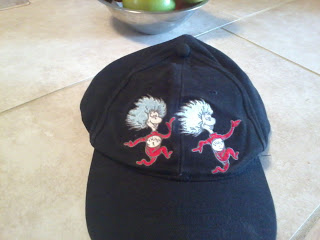
5. Do you have a Muse? Not a Muse in the traditional sense, but a few mascots and props--a favorite pen, a Squidward doll, and, of course, my beloved Thinging Cap.


6. What time do you write, day or night? I think I write better during the day, but between children and full-time employment, it has been a very long time since I've had any kind of writing routine at all. I have been incrementally trying to improve that situation over the last year or so, with some small success.

7. Describe your work area. It's a pretty standard issue small home office area--a cheap desktop computer on a cheap computer desk, the shelves and drawers of which are crammed full with writing guides, files with old work, etc. I do have the luxury of a ledge-style bookshelf that runs around two walls of the room. I need a ladder to fetch books down, but they make great company right where they are.

That's the official work area, but I have to admit that a lot of the real "work" of writing gets done the old-fashioned way with pen and paper on a lap desk in the living room or at a table in a quiet corner of the library or spread out on a blanket at the town park.

8. Who is/are your favorite author(s)? Way too many to name, which seems like a cop-out, I know, but to begin listing individual names would be to reveal far more about the depth of my reading addiction than I am prepared to share here.

9. What have you written so far (published or unpublished, poetry, etc)? Except for some appropriately adolescent poetry and a few angsty teenage short stories I wrote in high school and a few greeting card ideas I sold in my twenties, I have written only non-fiction--primarily essays and opinion pieces. I have about 20 publication credits, mostly in small magazines and newsletters. My "biggest" credits were in Woman's Day, The Writer and The Buffalo News. And, of course, I have been blogging for almost eight years--many of those posts don't count as "real" writing in my eyes, but a couple of them do.

10. What's your favorite color? My stock answer is purple, or shades thereof. But it really depends on the context, I think. I feel very strongly that certain colors are more appropriate for certain things than others. And I also feel very strongly that teal should simply not exist at all.

11. What's your favorite kind of pizza? With the exception of anchovies (the edibility of which is completely open to debate), the more toppings the better--mushrooms, peppers, onions are necessities--everything else is a bonus.

And, now, eleven random facts that I'm reasonably certain I have not revealed on the blog before...

1. For a period of time in the fourth grade, I chewed the ends of my hair. I don't remember now why I started or how I ever stopped.

2. "I can do better" is the thought that keeps me awake at night and the thing that gets me out of bed in the morning.

3. I rarely leave the house without a book or magazine and every time I do, I regret it.

4. I am currently involved in a passionate love affair with spinach. We've been meeting a couple of times a week and I still can't get enough. There's seemingly no end to the things that spinach can make better.

5. After months of Ancestry.com abstinence, I've recently had a relapse. Not only have I spent an absurd amount of time on the site these past few weeks, I've graduated to contacting county court clerks to request copies of records that aren't available online. I may be too far gone this time to ever come back.

6. The other night at work, I was rushing around like a multi-tasking madwoman panicking a little as my to-do list continued to grow despite my checking items off at a furious pace when I noticed that my thumb felt a little weird--warm and tingly. I didn't remember doing anything to it, but over the course of the next few hours, a deep wrap-around bruise appeared just above my top thumb knuckle, even turning my nail bed a disturbing purply blue. Somehow, without my even noticing, I managed to slam my thumb in something.* I was too busy to take care of myself, too busy to notice or recall a moment in which I did myself bodily harm. There's a metaphor in there somewhere. But I can't spare the time to figure it out.

7. Speaking of metaphors. Best passage I read all week: "After the accident I wasn't swimming, but I wasn't drowning either. Treading water, maybe? Holding my breath and going under, coming back up when I had to. Metaphors fall apart. They always do." ~~Joel Peckham, "Swimming" in The Sun, February 2013.

8. I was five when Baby Brother (who turns 39 today, by the way) was born. For about a week or so after he came home from the hospital, I was utterly convinced he was an elaborate inflatable doll. The scab on his umbilical stump covered the air valve; I was terrified someone would bump it and air would hiss out of him until he was completely deflated.

9. Sometimes I think I should get out more; sometimes I think it's better for everyone that I don't.

10. While trying to log into Facebook on my cell phone, I entered my password incorrectly and received the message: "Facebook is unable to authenticate you." I'm thinking of getting that printed on T-shirts and handing them out to everyone I know.

11. My need to park perfectly has gotten completely out of control--as has my outrage at people whose substandard parking skills make parking perfectly more difficult for me. C'mon, people! Those tidy white and yellow lines are not meant to be merely decorative!

And now, my questions for anyone reading who wishes to play along. If you post your answers, please be sure to let us know in the comments.

1. If time travel were possible, where would you go first? The past? The future? A specific time?

2. If you could claim any existing literary work as your own, what would it be?

3. You come upon a group of extraterrestrials disembarking from their ship in a deserted field. What is your first thought? First action?

4. I once read that smell is the sense most closely linked to memory. Which scent most strongly brings back childhood for you?

5. If you could rewrite the ending of a favorite book or movie, which one would it be and why?

6. Speaking of childhood, what food or foods make you wrinkle up your nose even now that you're a grown-up?

7. Who is the friend who's been in your life the longest? How did he or she come into your life?

8. Who has been your greatest teacher (inside the classroom or out)?

9. Do you have or have you ever had a nickname? Love it? Hate it?

10. What would the teaser on the back of your autobiography be?

11. Though you've no doubt been warned, do you nevertheless judge books by their covers?


*Injuring myself without noticing is anything but a rare occurrence. I am frequently covered in angry-looking bruises of all shapes and sizes that I have no memory of getting. At dinner one night at the halfway house, one of the clients looked at the four or five visible bruises on my arms and asked if I was being abused at home. I thanked him for his concern and assured him that the only one abusing me is me.

Wednesday, March 06, 2013

Ways I Am Not A Grown-Up, The Seventeenth In A Potentially Infinite Series


Peeps!

Need I say more?

On the off chance that I do need to say more, let me allow the ever-eloquent Elayne Boosler to speak on my behalf in this video recorded back in the olden days when Peeps were only available at Easter time and only in pink & yellow. Though Ms. Boosler and I part ways on the "properly aged" vs. fresh-from-the-package Peeps question, we share the same conflicted passion for Peeps.


Regarding the year-round availability of Peeps: though I do dearly love Peeps and have been known to eat myself into a Peeps-induced coma from time to time, I mostly do not consume the off-season versions (except for a slip now and then, which I generally regret--see: Christmas tree peeps incident). Apparently, Peeps Fever and Spring Fever coincide for reasons no doubt related to interplanetary alignments and hormonal fluctuations.

One last Peeps-related note: while positioning the Peeps for today's photo shoot, I noticed something I'd never noticed before--the "best by" date on the end of the Peeps boxes. I'm not sure whether I was more heartened or disturbed to discover that every box of Peeps I purchased had a "best by" date at least a year away and one of them was "best by" December 2014

Finally, I came to the conclusion* that it didn't really matter what I thought about the ridiculously long shelf life of Peeps, since none of them will be on my shelf 'til the end of this week, let alone the end of next year. 

*Said conclusion may or may not have been reached under the influence of 3/4 of a package of blue Peeps bunnies. Heh.

Saturday, February 16, 2013

In The Name of Love: A Twisted (& Belated) Valentine To Unrequited Love

I have a scar on the inside of my left wrist, just to the right of center, a tiny oval divot of missing flesh. It's been there since the day in fifth grade when Ricky Doud challenged me to a race--first one to the top of the monkey bars wins!

It turned out Ricky had ulterior motives. Once we were both at the top of the monkey bars perched on opposite rungs with the top bar between us, we spent a few minutes bickering about who had reached the top first (hint: it was me), but then he grabbed my wrist and pinned my hand down to the top bar.

"I love you," he said. "Do you love me?"

Now, Ricky was cute enough--dark, bowl-cut hair framing deep dimples and soulful brown puppy-dog eyes--but he was no Tony Cimino. And though I expended considerable effort covering my true emotions with nonchalance and fake hatred, Tony Cimino owned my ten-year-old heart--as he had owned my nine-year-old heart. In top secret declaration of my nearly two years' worth of undying love, I had even carved Tony's initials high on the trunk of the maple tree beside the chicken coop at our house. My heart was a loyal and stubborn thing, even then.

As far as I was concerned, Tony was the love of my life. I did not want to hurt Ricky's feelings nor did I want to profess a love I didn't feel--not even to get out of the hostage situation I suddenly found myself in. So, I said, "I don't know."

My attempt to dodge Ricky's question unleashed a dark side of Ricky I'd never seen before. He squeezed my wrist tighter and said, "Do you love me or not?"

I squirmed, as much from emotional discomfort as from any physical pain, and tried again, "I don't know. I'll tell you tomorrow."

Ricky pressed the nail of his index finger into the skin of my wrist, the glint of a threat in his eyes. Those eyes had gone from puppy-dog to Cujo in an instant. "Say you love me."

"I won't say it," I said. I looked him straight in the eye, daring him to carry through with his implied threat. Though he claimed to love me, he clearly did not know me at all. I was not the sort of girl to cower and squeal at bugs or snakes or mud puddles or fingernails pressed into my flesh. Not only was I not that kind of girl, I was ever-ready for the opportunity to prove how much not that kind of girl I was.

"Last chance," he said. "Say you love me."

I vigorously shook my head, my lips pressed tightly together to dramatically illustrate my resolve.

My skin gave way beneath Ricky's nail with a barely perceptible pop. When this failed to elicit either a whimper or a proclamation of love, Ricky's eyes met mine as his nail dug deeper and twisted, carving away a little piece of me. I pushed Ricky hard then, pulled my arm free and climbed down from the monkey bars without a word or glance in his direction.

That lifelong indentation on the inside of my wrist was the first scar I got in the name of love. It would not, of course, be the last.

Wednesday, February 06, 2013

Ode To A Complicated Man

"The beginning of love is to let those we love be perfectly themselves, and not to twist them to fit our own image. Otherwise we love only the reflection of ourselves in them." 
~~Thomas Merton1

My Pap, my paternal grandfather, was a complicated man. The wickedness of his sense of humor was matched only by the wickedness of his temper. By the time of my childhood, he was mostly a quiet man, given to solitary pursuits: reading, fishing, tying flies, staring blankly at the television while rolling itty-bitty balls of Scotch tape between his index finger and thumb. When a ball got good and gummy, he would stick it under the end table next to his chair. After he died, Nan and I found thirty or forty of these little balls wadded up under there like chewing gum on the underside of a diner table.

Whole afternoons could pass in the three-room house he shared with my grandmother without us hearing the sound of his voice. He tended to be most animated around company, though whatever mysterious spirits moved him sometimes did so at unpredictable times and it would be like the sun poking out on an overcast day--if the sun were not only shiny, but quick with a raunchy2 joke and possessed of a full-throttle wheezing laugh that was equal parts disturbing and infectious. For some reason, boredom maybe, these moods would often overtake him while he was driving longish distances. He would crank Juice Newton's "The Queen of Hearts" (he had the 8-track tape of that album in the player in his car) and sing along while make goofy faces or press the accelerator in time to the music. When these moods came over him, he would ask for a smooch on his stubbly cheek, he would dole out affectionate pats and squeezes, and he could be ridiculously generous with gifts and money.

His fits of temper, like his fits of good humor, seemed to sweep out of nowhere, triggered by the teeniest things. In those moments, if his bacon was a little too crispy, he would slam his hand or, worse, fist, down hard on the nearest flat surface and the resulting smack-thud would echo through every cell in my body. He would let loose a string of profanity which rarely made much sense and in which "goddamn" and "son-of-a-bitch" figured prominently. He sometimes called my grandmother stupid or lazy. Once, I saw him drive a steak knife into a wooden table top because she had forgotten to put the butter out for his noonday meal. It was not the forgetting so much as it was her frightened attempts to apologize and explain that seemed to set him off. I never saw him lay an angry hand on my grandmother, or anyone else for that matter, but he sometimes threatened to and in those moments when he was swept away by rage, it was difficult not to be utterly convinced that he might.

For all his oversized personality, my grandfather was not a big man. Even in his youth, before drinking and smoking and steelworking and finally emphysema ground him down, he was perhaps 5'7" or 5'8" and maybe 145 pounds. By the time he died at the age of 67, the steroids which had helped him breathe had so weakened his bones that he was not quite 5'5". He weighed 87 pounds when he entered the hospital for the last time.

Despite his ever-diminishing physical stature and declining health, there was a whole stretch of time during my childhood when I thought my grandfather might be the strongest man in the world or at least in the top ten. I was convinced there was nothing he couldn't do. No doubt his ferocious temper contributed to this illusion, but that wasn't the whole of it. He had freakishly strong hands--he kept a hand exerciser within reach of his rocking chair on the end table next to his breathing machine; until I was in my early teens, there was not a jar that man could not open. He could put together any toy we pulled out of a cereal box without even looking at the directions. With his bare hands, he could pick up a hot coal that rolled out of the wood stove. (I later learned this was less of a feat of fortitude and more a function of poor circulation in his hands.) He could spell Punxsutawney.


My grandfather was an abstinent alcoholic. Though he stopped drinking when my father was very young, I do not say "recovered" or "recovering" both because he never, to my knowledge, participated in any formal recovery-type program (including AA) and because he was, in many ways, exactly the kind of man that people in the recovery community would call a "dry drunk." A dry drunk is an individual who has quit drinking or using, but has failed to adequately address underlying emotional and psychological issues that contributed to addiction in the first place, issues that are often exacerbated by years of active drinking or use.

Pap was a classic dry drunk: moody and often miserable and wholly unwilling--or, given his time and place3, likely unable--to address the source of all his bitterness. He was more than that, though. Of course he was.

Oh, how I loved that man, with his messy, outsized personality. I loved him not in spite of his faults and certainly not because of them. My love for him simply existed alongside my knowledge of his faults. It was not "I love him, but..." and not, "I love him for..." but "I love him and I'm fully aware that he's a crazy sumbitch."

The knowledge that my heart was big enough to hold pure, undiluted love and not just the awareness of, but the acceptance of a whole, real person, warts and all was an invaluable gift my grandfather gave me. That, and the love of a naughty joke--oh! and the ability to spell Punxsutawney.


Pap & Me, 1968


1. As I was struggling with the finishing touches on this post, I clicked over to Facebook to rest my brain for a second and stumbled on this quotation, posted by one of my cousins. Timing is everything.

2. To this day, I cannot hear the Eagles' "Heartache Tonight" without hearing my grandfather's phlegmy remake of the lyrics, which, naturally, included the word "hard-on." And don't even get me started on the flag raising story, which, naturally, made great use of the phrase "blow the bugle."

3. Born February 6, 1919 just outside of Pittsburgh, Pennsylvania.


Tuesday, February 05, 2013

Random Quote Tuesday

"Logic was, I first thought, like a train. Get on it and the rails would carry everyone to the same destination, and when they got there, they'd see it was the only place to be. But I soon understood that, outside of arithmetic class, logic was more like a taxi. You told it where to take you, and it took you there. If you were in favor of the death penalty, it found a street that led to the electric chair and nailed the accelerator to the floorboard. If you hated the death penalty, it took the same street just as fast, but in the opposite direction."

~~Andrew Hudgins, "Helen Keller Answers The Iron" from The Kenyon Review in The Pushcart Prize XXXVII: Best of the Small Presses


Monday, February 04, 2013

Masked Mom's Media Monday: Blogging

I've missed it.

I have a folder full of half- and three-quarters-written posts that should've been posted months ago. So, for the next few weeks, you may stumble upon some posts that would've been timely in mid-November. In other words (as always), read at your risk.


Masked Mom's One-Two-Word Review: I'm back-ish.